

Issued by: Trans Canada Trail

Submission Closing Deadline
Date: December 5, 2025
Time: 5:00 pm Eastern Standard Time (EST)
Submission contact: kgabora@tctrail.ca
Vendors must submit their proposals using the form below. Late submissions will not be considered. Please ensure your proposal is in PDF format and includes “RFP – Volunteer Engagement Framework” in the file name.
Jump to section:
- Introduction
- Proposal Preparation
- Proposed Services and Qualifications
- Evaluation
- Terms and Conditions
Purpose of the RFP
Trans Canada Trail (TCT) is seeking proposals from qualified consultants or firms to develop a comprehensive Volunteer Engagement Framework that strengthens and unifies volunteerism across the organization and its nationwide network.
The Volunteer Engagement Framework will guide how TCT engages, supports, recognizes, and sustains volunteers across all levels of the organization—including the national office, Board of Directors, committees, philanthropic initiatives, and the more than 500 local trail groups that steward the 29,000-kilometre Trans Canada Trail. The purpose of this RFP is to identify an experienced partner who can design a framework that enhances the volunteer experience, aligns with TCT’s strategic plan and values, and supports the long-term vitality of the national trail network.
The maximum budget for this project is $50,000.00, inclusive of all expenses.
The resulting Volunteer Engagement Framework will:
- Assess the current state of volunteerism across TCT and its partner network
- Identify opportunities to expand volunteer participation, retention, and leadership
- Recommend structures, tools, and policies to improve coordination and recognition
- Define measurable outcomes and implementation steps for a cohesive national volunteer program
- Ensure that TCT’s volunteer initiatives advance inclusion, reconciliation, climate resilience, and community engagement objectives
The Volunteer Engagement Framework will serve as a cornerstone for building national capacity, empowering local trail organizations, and strengthening the culture of stewardship that sustains Canada’s Trail for generations to come.
1.0 Introduction
1.1 Trans Canada Trail background
Trans Canada Trail (TCT) is the world’s longest recreational network, spanning over 29,000 km across urban, rural, and remote landscapes. As a national organization, we promote the use, development, and stewardship of the Trail while enhancing the connection between Canadians and nature.
- Our role: Trans Canada Trail is the organization that advocates for, stewards and champions Canada’s nationwide trail system, providing leadership and guidance, funding and resources, outreach and engagement.
- Our vision: We envision a future in which everyone embraces the outdoors, connects with one another and experiences the restorative power of nature along Canada’s trails.
- Our mission: Through collaboration and partnerships, we lead, develop and steward an accessible nationwide system of connected urban and rural trails.
Two legal entities work together to achieve the mission of Trans Canada Trail: to connect Canadians and visitors to nature and to one another, from coast to coast to coast, through accessible and inclusive outdoor activities. Trans Canada Trail (the organization) was established in 1992; it stewards and promotes the usage of the national trail in collaboration with community-based partners. Trans Canada Trail Foundation, a charitable foundation, was created in 2010 to raise funds to support the Trans Canada Trail. Trans Canada Trail (TCT) and Trans Canada Trail Foundation (TCTF) are each governed by an independent Board of Directors; however, they operate as a consolidated entity.
The organization has an enterprise risk system that is updated annually and should be used as a resource to help develop the annual risk-based audit plan. Imagine Canada also accredited the organization.
For further information, visit: www.tctrail.ca
The TCT project lead is Kristen Gabora, Director, Partner Services and Support who will manage the overall relationship with the successful proponent. This Project Lead will assist the successful proponent in identifying key players to be interviewed, provide access to files containing previous reports and data sources, and assist the proponent in accessing information required to complete the audit plan for each assignment. The project lead will be the key contact for the successful proponent.
2.0 Proposal Preparation
2.1 Proposal Format
All proponents are asked to organize their proposals in the same manner and order as shown in Section 4.0 – Evaluation of this document. Proponents are free to include additional material in appendices; however, only the main body of the proposal will be evaluated.
Proponents are to limit the size of their proposal to a maximum of 15 pages, including any attachments or appendices.
Proponents are to limit the size of their proposal to a maximum of 15 pages, including any attachments or appendices.
2.2 Additional Information
All documentation materials submitted to the proposals should be clearly indicated in a table of contents.
3.0 Proposed Services and Qualifications
3.1 Statement of Requirements – Scope of Work
The TCT will develop a comprehensive Volunteer Engagement Framework designed to strengthen and unify volunteer efforts across its national network. This Framework will establish a cohesive structure, clear standards, and practical tools to enhance the recruitment, training, coordination, recognition, and retention of volunteers, in alignment with TCT’s 2024–2029 Strategic Plan.
Building on the deep tradition of volunteerism that sustains Canada’s Trail, this project will also advance emerging priorities in climate resilience, inclusion, Indigenous partnerships, and community connection.
The Volunteer Engagement Framework will:
- Establish a consistent, organization-wide approach to volunteer engagement.
- Identify and address gaps and challenges in current volunteer management practices.
- Align volunteer engagement activities with TCT’s mission, values, and strategic pillars.
- Strengthen capacity at the national, regional, and local levels to support sustainable and inclusive volunteer participation.
3.1.1 Current State Analysis
- Conduct an audit of existing volunteer engagement practices across departments.
- Assess volunteer management systems and digital tools (e.g., Salesforce).
- Identify strengths, gaps, redundancies, and inconsistencies in volunteer experiences and support.
3.1.2 Stakeholder Engagement
- Engage key internal and external stakeholders, including:
- TCT staff across departments
- Volunteer Board and Committee members
- Trail groups and local operators
- Philanthropy volunteers
- Corporate partners with employee volunteerism programs
- Indigenous partners (in coordination with TCT’s Indigenous Advisory Committee)
- Use diverse engagement methods (surveys, focus groups, interviews, roundtables) to ensure inclusive input.
3.1.3 Market Scan
- Benchmark best practices from national and international nonprofit/charities and trail organizations.
- Review leading models for volunteer recognition, training, risk and liability management, and digital infrastructure.
3.1.4 Framework Development
- Develop a tiered, lifecycle-based framework addressing distinct volunteer types (e.g., trail maintenance, governance, episodic, skills-based).
- Define clear roles, responsibilities, and governance structures for volunteer management at different organizational levels.
- Establish key performance indicators (KPIs) and a performance measurement framework.
- Ensure scalability and flexibility to accommodate regional and cultural differences across Canada.
3.1.5 Tools and Resources
- Create core tools, templates, and guides (e.g., role descriptions, onboarding materials, engagement plans).
- Recommend or design digital systems for volunteer communication, data management, and recognition.
- Develop an inclusive volunteer recognition model aligned with donor stewardship practices.
3.1.6 Integration with Philanthropy and Community Engagement
- Identify intersections between volunteer engagement and philanthropy.
- Explore opportunities for peer-to-peer fundraising and ambassador activation.
- Recommend storytelling and communication approaches to elevate volunteer impact.
3.1.7 Diversity, Equity, and Inclusion (DEI)
- Embed DEI principles to ensure accessibility and inclusive volunteer participation.
- Prioritize outreach to underserved populations, including Indigenous communities, youth, and newcomers.
3.1.8 Project Timeline
We anticipate the project will take approximately 4–6 months to complete, beginning in January 2026. A detailed workplan and schedule must be included in the proposal.
3.2 Experience and Qualifications
Proponents are required to provide an overview of their business’ background and capabilities applicable to the needs and profile of Trans Canada Trail. Proponents should describe their knowledge and understanding of charities, small not-for-profit organizations operating with national scope. Proposals must include information on the range and type of services relevant to Trans Canada Trail and comparable clients and information on 3rd party vendors.
3.3 Approach, Methodology and Innovation
Proposals should describe the methodology used to develop to deliver the scope of work, including key activities and deliverables. They should also describe project types (assurance, advisory, etc.), coverage, performance measures, technology enablers, and other key elements of the plan.
Proposals should include an annual cycle of activities outlining major tasks, timeframes, resource requirements, and deliverables as part of their submission. In addition, the proponent should state all assumptions used in preparing the annual audit plan.
Proposals should describe key deliverables and timelines, including:
- Proposed approach, methodology and deliverables for each phase of projects (planning, execution, reporting)
- Senior management Engagement
- Samples of previous direct mail campaigns?and other deliverables
3.4 Professional Resources
Specific information should be submitted with respect to all staff members who are proposed to have roles and responsibilities for Trans Canada Trail and should include the following:
- Name and professional credentials
- Position in the firm
- Experience and certifications
- Hourly rate where applicable
Describe the team structure and how this will align with the proposed approach.
3.5 Proposal Price Details
Proposals shall include a detailed description of all fees and the recommended method of billing and payment, including methods proposed for interim or phased billings, if any. Please note that any RFP submitted to TCT must include pricing details for the submission, otherwise, it may be subject to rejection.
3.6 References
Any proposal response should include a minimum of three (3) references. Reference contacts should be notified that Trans Canada Trail may contact them as part of the evaluation process. These references should include clients whose involvement with the responding firm is comparable to the services being proposed for Trans Canada Trail.
The successful proponent will provide a template of acceptable contract terms and conditions to Trans Canada Trail within two (2) weeks after notification of acceptance of its proposal. Proponents should identify any revisions to terms that they require or provide alternatives where necessary.
4.0 Evaluation
4.1 Evaluation Criteria
Trans Canada Trail will employ a structured, competitive evaluation process. All written proposals will be reviewed and scored based on how well they address the specific needs of Trans Canada Trail as outlined in this Request for Proposals. Trans Canada Trail will determine the firm whose proposal best suits its needs based upon review and selection criteria as follows:
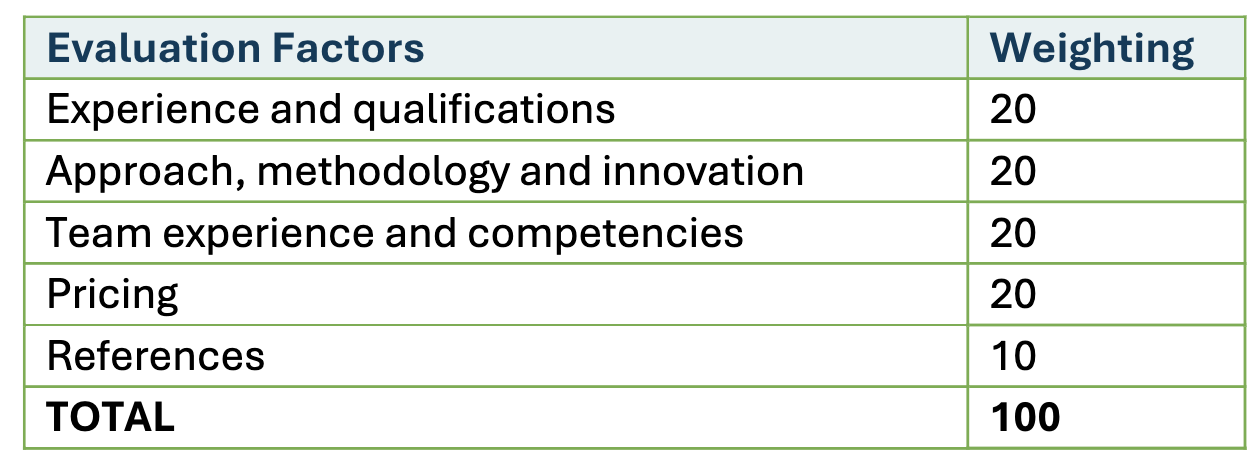
*Trans Canada Trail may choose, solely at its discretion, to conduct interviews/presentations with short listed firms.
4.2 Assumptions
Proponents must document any assumptions made in the preparation of their proposal.
5.0 Terms and Conditions
5.1 Description
This Request for Proposal (the “RFP”) is an invitation by Trans Canada Trail to receive proposals from qualified proponents for a Volunteer Engagement Strategy.
5.2 Non-binding Procurement Process
The process will be governed by the terms and conditions of the RFP, and that, among other things, such terms and conditions confirm that this procurement process, does not constitute a formal, legally binding bidding process or tender, and that no legal relationship or obligation, if any, regarding the procurement of any good or service shall be created between Trans Canada Trail and the proponent unless and until a fully executed contract between Trans Canada Trail and the proponent execute a written agreement for the Deliverables.
5.3 Submission Closing Deadline/Delivery
All vendors must complete the online submission form and upload their proposal as a single PDF document by Friday December 5, 2025, at 5:00 p.m. (Eastern Standard Time).
The submission form and upload portal can be accessed below.
Submissions received after the closing date and time will be disqualified from competition. Trans Canada Trail will not make allowances for delays due to factors such as email server delays and power outages. Trans Canada Trail strongly encourages proponents to avoid waiting until the final calendar day to submit responses to mitigate any unforeseen circumstances.
5.4 Enquiries
Any questions related to this RFP are to be directed via email only to kgabora@tctrail.ca and received no later than November 28, 2025.
Please reference “RFP – Volunteer Engagement Strategy ” in the email’s subject line.
Proponents and their representatives are not permitted to contact any employees or other representatives of Trans Canada Trail, other than the contact noted above, concerning matters of this RFP, unless the above contact has specifically directed you to another to respond. Trans Canada Trail reserves the right to disqualify any proponent that does not comply with this requirement and reject the proponent’s submission.
Anyone who believes the RFP contains any error, inconsistency, or omission should submit a written inquiry via email requesting clarification, interpretation or explanation to the Trans Canada Trail contact identified above.
5.5 Proposal Contents
All proponents are asked to organize their submissions in the order outlined in Section 4.0. Proponents should include a Table of Contents in their response.
5.6 Addenda
It is the responsibility of proponents to ensure that they have all the necessary information concerning the intent and requirements of this RFP, and to seek clarification of any matter they consider to be unclear before forwarding a submission. Trans Canada Trail is not responsible for any misunderstanding of this RFP on the part of a proponent. No proponent can claim any advantage from any error, inconsistency, or omission in this RFP.
No information given verbally by Trans Canada Trail, or by means of telephone, will be binding, nor will it be construed to change the requirements of the RFP in any way.
Trans Canada Trail reserves the right to modify the terms of the RFP before the closing deadline, such changes to be communicated from Trans Canada Trail in the form of an addendum to all proponents.
5.7 Confidential Information of Proponent
A proponent should identify any information in its submission, or any accompanying documentation supplied in confidence for which confidentiality is to be maintained by Trans Canada Trail. The confidentiality of such information will be maintained by Trans Canada Trail, except as otherwise required by law (including, without limitation the requirements of the Freedom of Information and Protection of Privacy Act, S.N.S. 1993 (“FOIPOP”), as amended from time to time) or by order of a court or tribunal. Proponents should review and understand the effect of FOIPOP on their submissions, including the criteria related to third party confidential information. Proponents are advised that their submissions will, as necessary, be disclosed on a confidential basis, to Trans Canada Trail’s advisors retained for the purpose of evaluating or participating in the evaluation of their submissions. If a proponent has any questions about the collection and use of confidential information pursuant to this RFP, questions are to be submitted to Trans Canada Trail’s contact.
5.8 Taxes
Applicable taxes of HST shall be included as separate pricing in the submitted price.
5.9 Standard Clauses
An incomplete submission and submissions that fail to comply with the specification documents will be rejected. If a submission fails to satisfy all the mandatory requirements, Trans Canada Trail will issue the proponent a rectification notice identifying the deficiencies and providing the proponent an opportunity to rectify the deficiencies. If the proponent fails to satisfy the mandatory submission requirements within the Rectification Period of one day, its proposal will be excluded from further consideration. The Rectification Period will begin to run from the date that Trans Canada Trail issues a rectification notice to the proponent.
The entire content of the proponent’s submission should be submitted in a fixed form, and the content of websites or other external documents referred to in the proponent’s submission but not attached will not be considered to form part of its proposal.
5.10 Withdrawal of Submissions
At any time throughout the RFP process, until the execution of a written agreement for provision of the Deliverables, a proponent may request to withdraw a submission. To withdraw a submission, a notice of withdrawal must be sent to Trans Canada Trail’s contact and must be signed by an authorized representative of the proponent. Trans Canada Trail is under no obligation to return withdrawn submissions.
5.11 Submissions to be retained by Trans Canada Trail
Trans Canada Trail will not return the submissions, or any accompanying documentation submitted by a proponent.
5.12 Contract Negotiations
The selected proponent will be requested to enter into direct contract negotiations to finalize an agreement with Trans Canada Trail. The proponent shall accept and agree that only contracts or amendments signed by the Chief Executive Officer will be valid.
5.13 Governing Law and Interpretation
These Terms and Conditions of the RFP Process:
- are intended to be interpreted broadly and independently (with no particular provision intended to limit the scope of any other provision);
- are non-exhaustive and shall not be construed as intending to limit the pre-existing rights of the parties to engage in precontractual discussions in accordance with the common law governing direct commercial negotiations; and
- are to be governed by and construed in accordance with the laws of the province of Ontario and the federal laws of Canada applicable therein.
5.14 Conflict of Interest
Trans Canada Trail may disqualify a proponent for any conduct, situation or circumstances, determined by Trans Canada Trail, in its sole and absolute discretion, to constitute a Conflict of Interest. For the purposes of this, the term “Conflict of Interest” includes, but is not limited to, any situation or circumstance where: in relation to the RFP process, if the proponent has an unfair advantage or engages in conduct, directly or indirectly, that may give it an unfair advantage, including but not limited to: (i) having, or having access to, confidential information of Trans Canada Trail in the preparation of its proposal that is not available to other proponents, (ii) communicating with any person with a view to influencing preferred treatment in the RFP process (including but not limited to the lobbying of decision makers involved in the RFP process), or (iii) engaging in conduct that compromises, or could be seen to compromise, the integrity of the open and competitive RFP process or render that process non-competitive or unfair; or in relation to the performance of its contractual obligations under a contract for the Deliverables, the proponent’s other commitments, relationships or financial interests (i) could, or could be seen to, exercise an improper influence over the objective, unbiased and impartial exercise of its independent judgement, or (ii) could, or could be seen to, compromise, impair or be incompatible with the effective performance of its contractual obligations.
Proponents should disclose the names and all pertinent details of all individuals (employees, advisors, or individuals acting in any other capacity) who (a) participated in the preparation of the proposal; AND (b) were employees of Trans Canada Trail within twelve (12) months prior to the Submission Deadline.
5.15 Notification of Successful Proponent(s)
Notification of the successful proponent will be via direct communication.
5.16 Evaluation and Selection
An Evaluation Team will review and score the submissions received in response to the RFP. Upon selection of the most qualified proponent, Trans Canada Trail will begin negotiations in order to secure a contract. Should Trans Canada Trail be unable to negotiate a satisfactory contract with the proponent considered to be most qualified, negotiations with that proponent will be formally terminated. Trans Canada Trail may then undertake negotiations with the next most qualified proponent. Refer to Evaluation Percentages in the Specification for details of evaluation and award.