
How Accessibility Upgrades on the Trans Canada Trail Help Bring Nature to All

Though a seemingly minor change to a trail — like a new crosswalk or widened sidewalk — may not seem newsworthy, for many people across Canada, accessibility improvements can make a world of difference when it comes to opening the door to nature and trails.
“There are so many benefits to using trails, to getting outside and being active,” says Trisha Kaplan, Director, Centre for Trail Excellence with Trans Canada Trail. “There is an incredible diversity of people who want to enjoy these benefits, and some people will be able to do so, while others will face barriers that can be difficult to fully appreciate without having that lived experience. Creating accessible public spaces should matter to all of us and is a priority at Trans Canada Trail.”
Below, we’ve taken a look at three trail projects focused on accessibility upgrades — and examined how these upgrades are removing physical barriers, improving safety and creating more inclusive outdoor experiences in nature for all trail users.
A new sidewalk and two crosswalks in Innisfail, Alberta
In summer 2025, the Town of Innisfail constructed a new sidewalk and two crosswalks along 56th Street, running through the Town of Innisfail Trail near Dodds Lake. This project grew out of previous accessibility mapping, which had identified the lack of curb cuts or smooth surface at this location. The addition of the north-side sidewalk and redesigned crossings means that individuals now have a safer and barrier-free route to access the Trans Canada Trail. The project was funded in part by Trans Canada Trail’s Trail Catalyst Fund.
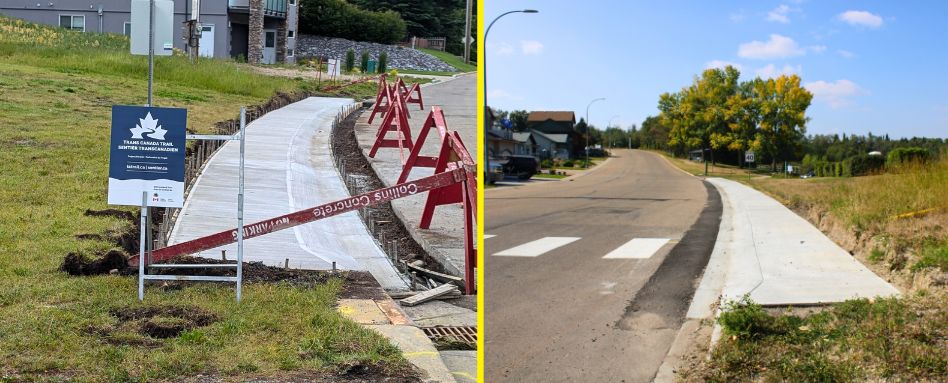
Left: Town of Innisfail Trail undergoing improvements. Right: The completed accessible crosswalk. Photo credit: Alison MacDonald
Improved trail safety thanks to three upgraded rail crossings in Guelph, Ontario
Along the Goderich to Guelph Trail – City of Guelph trail in Ontario, upgrades to three rail crossings have significantly improved safety and accessibility for trail users. The former rubber mat and asphalt surfaces were uneven and prone to deterioration, which could create hazards for cyclists, pedestrians, and people using mobility devices. With funding from Trans Canada Trail, the rail crossing surfaces were replaced with concrete, minimizing gaps between the rail and trail surfacing. As a result, the crossings are not only safer options for trail users, but also more durable and will require less maintenance going forward.
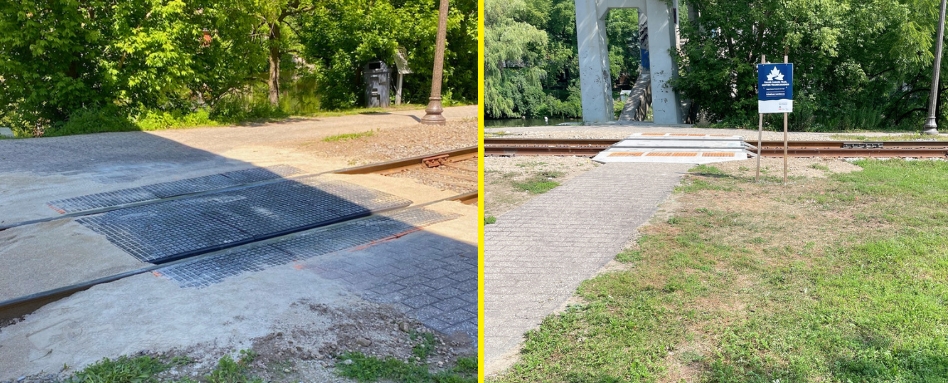
Left: Before: A rail crossing in need of repair. Right: After: An upgraded, safer rail crossing. Photo credit: City of Guelph.
Stabilizing the trail at FortWhyte Alive in Manitoba
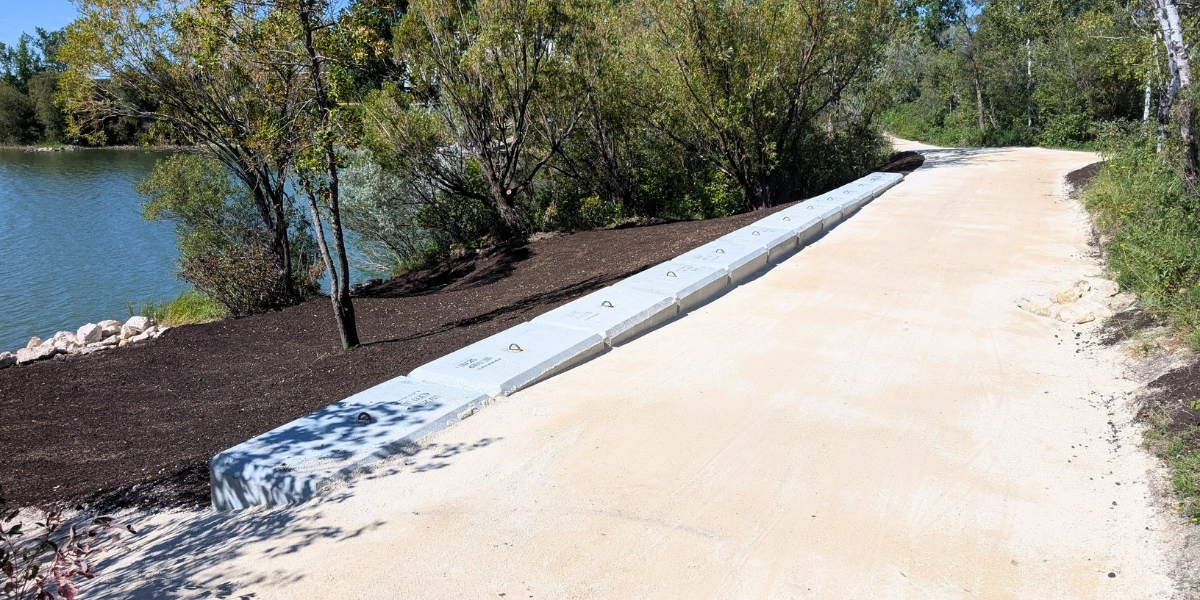
Running through the 660-acre FortWhyte Alive park in Winnipeg, Manitoba, a section of the City of Winnipeg Trail was in need of important stabilization work. With funding from an Infrastructure and Adaptation grant, work got underway: crews excavated the area down to solid clay, installed base and drainage systems, and the area was filled with crushed stone and compacted, and the trail section was restored. The result is a safer trail experience for all users.
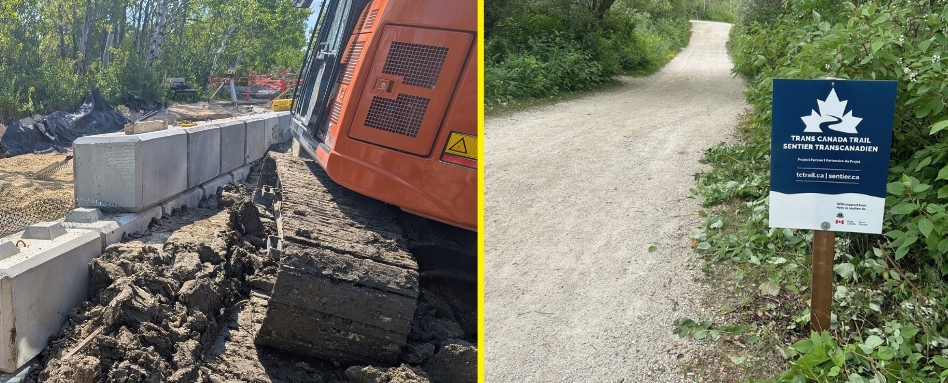
Left and right: Repairs underway at FortWhyte Alive. Photo credit: FortWhyte Alive.
About the Trail Catalyst Fund
Our Trail Catalyst Fund is a comprehensive funding initiative designed to enhance the quality, connectivity and sustainability of the national trail network. It supports strategic investments in trails and the trail sector, all with the goal of fostering a safe, inclusive and resilient Trans Canada Trail.
Applicants can access a wide range of funding support, including financial support towards infrastructure, maintenance and signage projects. and accessibility and inclusion projects.
Find about more about the Trail Catalyst Fund.
Learn more about creating All Persons Trails.
Feature photo credit: FortWhyte Alive.