
Cathy’s Trans Canada Trail: A Tale of Two Rivers

Exploring the Trans Canada Trail in New Brunswick
Written by Cathy Donaldson
In the Fredericton Capital Region, morning fog drifts over the Saint John River/Wolastoq as runners cross the Bill Thorpe Walking Bridge — named for a longtime city councillor and trail advocate.
Two hours away, along the Petitcodiac River in the Greater Moncton communities of Moncton, Dieppe and Riverview, the tidal bore rolls upriver — a wave driven inland by the powerful tides of the Bay of Fundy.
These two New Brunswick regions — Fredericton and Greater Moncton — reveal how different rivers and their surrounding communities shape the Trans Canada Trail experience in the province.
Fredericton: Meandering along the Saint John River/Wolastoq
The Fredericton Capital Region is frequently described as a walker’s paradise. Portions of its trail network are part of the Trans Canada Trail, including the South Riverfront Trail. This downtown stretch passes through a floodplain valley lined with parks, public art and landmarks such as Old Government House, Christ Church Cathedral and the Beaverbrook Art Gallery.
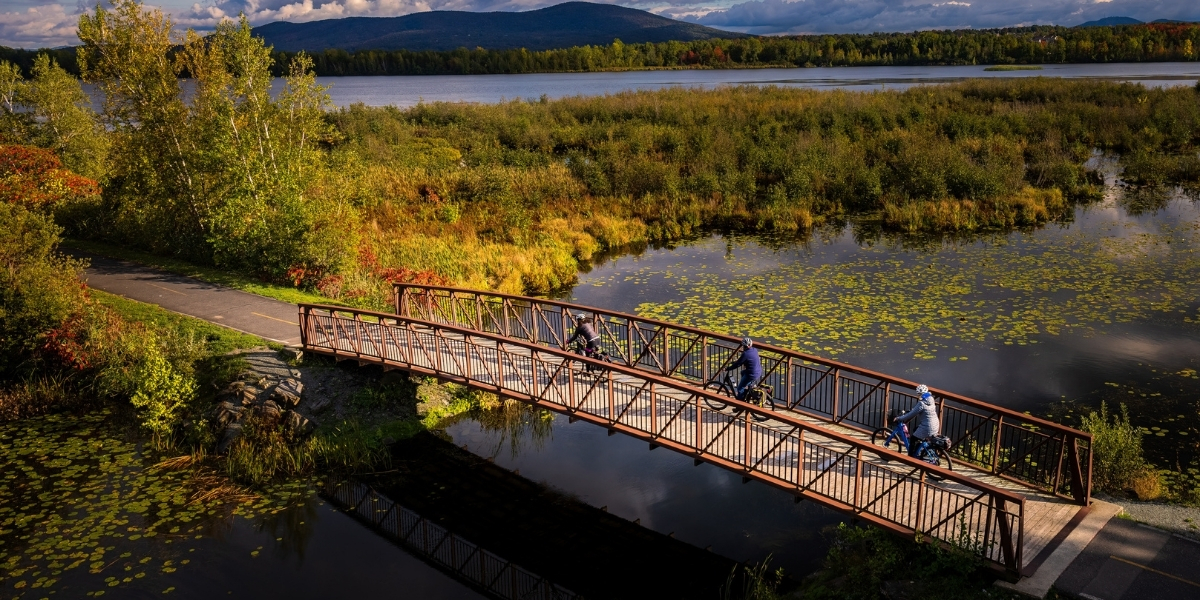
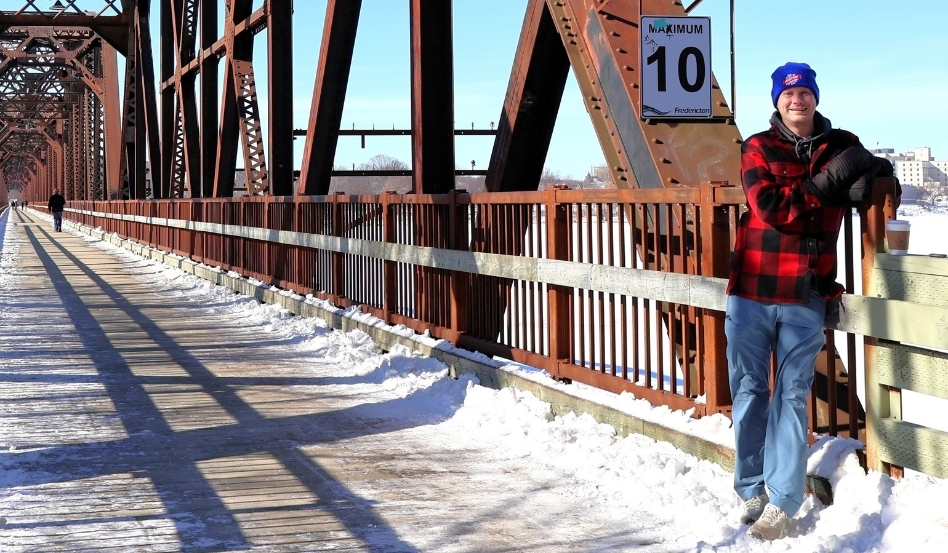
The route continues over the Bill Thorpe Walking Bridge, a former railway span, now used by more than 500,000 pedestrians and cyclists annually.
On the other side of the river, the North Riverfront Trail winds through Carleton Park, past wetlands and boardwalks where ospreys and great blue herons hunt along the managed marsh.
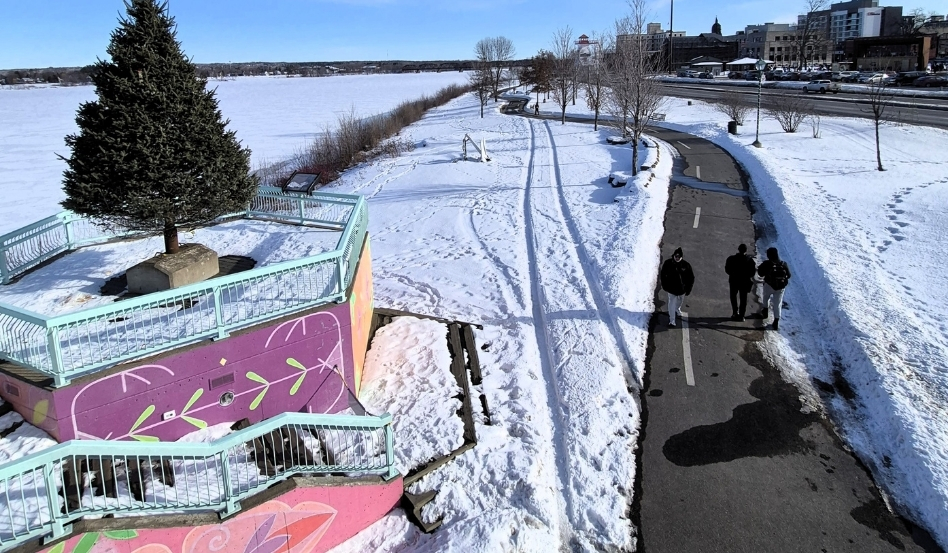
Walkers enjoy a winter day on Fredericton’s South Riverfront Trail, part of the Trans Canada Trail network along the Saint John River (Wolastoq), seen here from a downtown overpass. Photo credit: Cathy Donaldson
Both sections of the Trans Canada Trail are part of everyday life for many residents, said Stephen Marr, president of the Fredericton Trails Coalition.
“Weather permitting, they’re used daily for walking or cycling,” said Marr. “People commute to work, take a lunchtime fresh-air break, head out for errands or walk to school. They’re a real asset to our communities.”
The Trans Canada Trail is certainly key to the daily routine of Greg McCann, who starts his workday by parking his car near Picaroons Roundhouse, a north-side craft brewery.
“From the parking lot, I walk the Trail to and from work (in Downtown Fredericton) and run along the Trail most noon hours,” he said. “Crossing the Bill Thorpe Walking Bridge over the river each morning is a bit of a zen moment. The Trail has a beauty in each weather type — sunny, foggy, snowy, rainy. It’s very relaxing.”
Debbie Perry enjoys walking her dog, Dexter, across the region but holds a soft spot for the riverfront trails.
“I’m a huge advocate,” she said. “The fact that you can be in nature within minutes, with the water and the trees, makes me feel lucky to have these trails.”
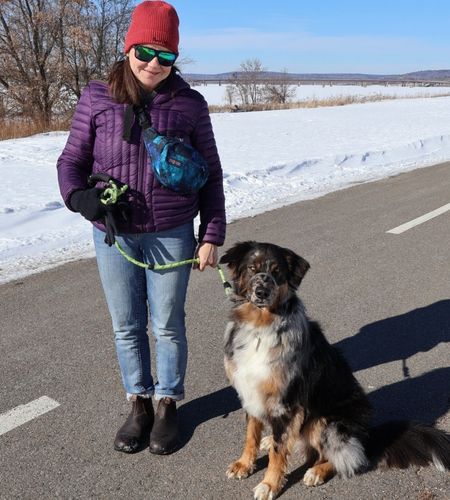
Debbie Perry walks her dog Dexter along the North Riverfront Trail, part of the Trans Canada Trail network, beside the Saint John River (Wolastoq) in Fredericton. Photo credit: Cathy Donaldson
Greater Moncton: Moving with the Petitcodiac tides
Two hours southeast of Fredericton, the Trans Canada Trail traces a river with a different temperament.
The Petitcodiac River — dubbed the “Chocolate River” for the brown-coloured sediment stirred up by the Bay of Fundy tides — lies at the heart of the neighbouring communities of Moncton, Riverview and Dieppe, collectively known as Greater Moncton. Trail users can witness the dramatic tidal changes of the Petitcodiac, where wide mudflats at low tide fill as the incoming water pushes upriver. That tide is announced by a tidal bore, a small wave marking the leading edge of the tide.
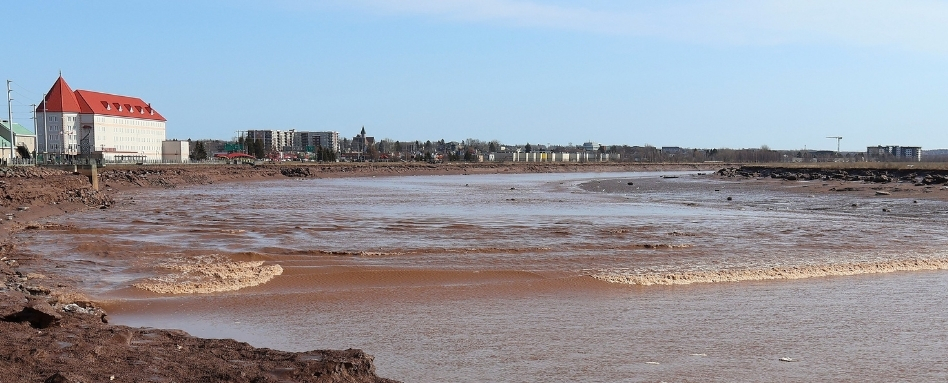
The tidal bore rolls upriver along the Petitcodiac River in Moncton, New Brunswick, a phenomenon that can be viewed from sections of the Trans Canada Trail along the riverfront. Photo credit: Cathy Donaldson
The tidal bore phenomenon can be seen at numerous points along the Trans Canada Trail, on the Riverfront Trail section. It stretches about 15 kilometres along the Petitcodiac and is one of the region’s most popular routes for walking, running, cycling and birdwatching.
A stroll along the Moncton and Dieppe sections of the Riverfront Trail reveals a series of landmarks, such as the Acadian Odyssey Monument honouring Acadian history, the restored Treitz Haus — the oldest surviving building in Moncton — and tidal-bore viewing areas at Bore Park.

John Dallaire runs along the Riverfront Trail in Moncton, part of the Trans Canada Trail network. Photo credit: Cathy Donaldson
Across the Petitcodiac in Riverview, the Trail continues along the river’s south bank, connecting neighbourhoods with parks and scenic lookouts.
For Ash Arrowsmith, a local resident and the Town’s Community Recreation Coordinator, the Riverfront Trail on this side is woven into both family life and community programming.
He walks and bikes the Trail with his family, geocaches along its wooded edges and brings visiting friends there for their first look at the Petitcodiac.
“The Chocolate River is definitely a source of pride and connection to the Bay of Fundy,” said Arrowsmith. “It’s the nature factor — watching the water flow by, seeing eagles overhead and those incredible sunrises and sunsets. It’s just unbelievable.”
In December and early January, the Trail becomes part of Riverview’s annual Light Up celebration. Thousands of coloured lights strung in the trees illuminate the Trail. More than 28,000 people checked out the spectacle last year.
John Dallaire of Moncton enjoys the impressive display. He has walked, cycled and pushed his grandson in a stroller along many sections of the Trail. But the avid runner — who has completed 47 marathons and numerous other races — now mainly uses the route to train with local running groups.
“In the summer, we’re there three or four days a week,” he said. “The Running Room store is located right along the Trail, so we’ll often leave from there and head to the riverfront. Sometimes we even try to beat the tidal bore to the bridge, running to keep up with it. It’s so much fun.”
Municipal officials say the riverfront — and the Trans Canada Trail corridor — continue to evolve as hubs for recreation and community gatherings.

Joined by his partner and daughter, Ash Arrowsmith cycles along Riverview’s Riverfront Trail, part of the Trans Canada Trail network beside the Petitcodiac River. Photo credit: Cathy Donaldson
“The City of Moncton is currently developing a long-term Riverfront Master Plan aimed at enhancing public spaces along the Petitcodiac River and strengthening connections between the riverfront, downtown and the region’s growing network of walking and cycling trails, including the Trans Canada Trail,” said Isabelle LeBlanc, General Manager of Community Services for Moncton.
Though the rivers move in distinct ways — the Saint John/Wolastoq usually flowing unhurried, the Petitcodiac responding to the Bay of Fundy’s tides — both have shaped the riverfront trails that bring people to the river’s edge. In both cases, the Trans Canada Trail has become a shared space for movement, time in nature and community connection.
Cathy Donaldson is a travel writer based in Moncton, New Brunswick. Read more about her adventures at:
• Website: www.cathydonaldson.ca
• Facebook: https://www.facebook.com/cathy.k.donaldson
• Instagram: @cathykdonaldson
• LinkedIn: @cathydonaldson
• Threads: @cathykdonaldson
**
Discover more New Brunswick Trails on our interactive map!
About Trans Canada Trail
Stretching 30,000 kilometres across every province and territory, the Trans Canada Trail is cared for locally by trail and community groups. As a charity, Trans Canada Trail advocates for and stewards this nationwide system. We support community-led trail projects through the Trail Catalyst Fund and we share reliable trail knowledge through the Centre for Trail Excellence.
Greg McCann pauses on the Bill Thorpe Walking Bridge in Fredericton, a former railway bridge now part of the Trans Canada Trail network linking the north and south sides of the Saint John River (Wolastoq). Main photo credit: Cathy Donaldson