
Bronwyn’s Trans Canada Trail: Drawn in by Dawson

Written by Bronwyn Preece
I hit the tarmac and then the trail.
I had just ascended 15 parallels by flight. I had landed as a visitor in the Ancestral and Contemporary Territory of the Tr’ondëk Hwëch’, whose Traditional Law — Tr’ëhudè — is “to care for those who travel these lands with us.”¹ I immediately felt welcomed.
I had flown here as a hiker — “the backcountry poet” — one who loves to learn through footfalls, the rhythms and stories of a place — old and new. One who has come to appreciate the intersection of tales and trails, legends, lore and learning through walking, talking, stopping, asking, listening, engaging, and carrying newly acquired knowledges in, and through, my next steps forward. And this is why, my first stop, would be the Trans Canada Trail as my point of entry into Dawson City.
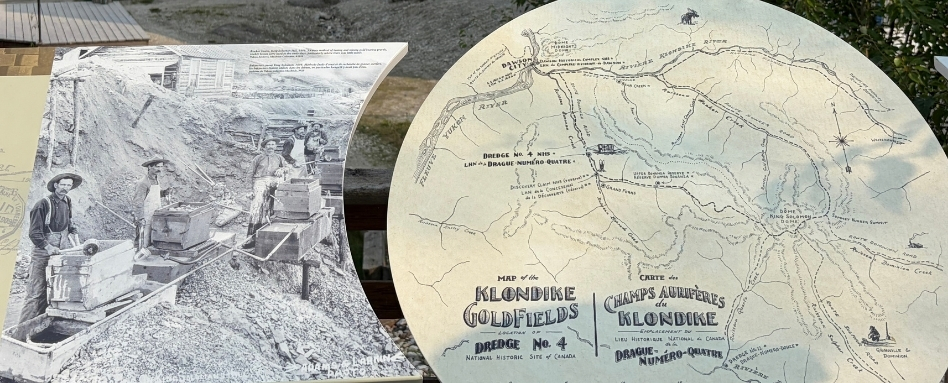
Photo credit: Bronwyn Preece
The Trans Canada Trail in Dawson City
The Trans Canada Trail in Dawson proper is made up of a 6 km route that circumnavigates the town famed for being the epicentre of the Klondike Gold Rush in the late 1800s/early 1900s. Gold mining is still hugely integral to the small community, with packhorses and panning being replaced by high suspension trucks and placer style extraction techniques. With the price of ore at record highs, some suggest this is another Gold Rush. The word Klondike, I would learn, was a mispronunciation of the Indigenous name Tr’ochëk:
“Tr’o refers to a special rock – hammer rock – used to drive salmon weir stakes into
the river bed. Ndëk is a water way or river.” ~Elder Angie Joseph-Rear²
The Tr’ondëk Hwëch’ lived at the mouth of the Klondike River: Tr’ondëk. Their name loosely translates to the People who lived [t]here at its delta.
Dawson City sits — and is sinking — in this floodplain and on permafrost: at the confluence of the Klondike and the Yukon Rivers.
Tr’ondëk/Dawson: a confluence, a culture jam, a historical and living epicentre of both connection and contradiction…
I had my map from the tctrail.ca website and one picked up from the airport brochure rack. As I was aware that the portion that formed part of the Trans Canada Trail circled the town, there was no designated entry point. And so I chose to begin riverside — along the dyke — opposite Front Street, the main town frontage, across from the Visitor and Parks Canada Centre, and next to the Dänojà Zho Cultural Centre. The Centre was closed, however, outside — next to a painted orange rock which read “Every Child Matters” — was a sign that included these powerful lines:
“We invite you to reflect on the historical relationship with the First Peoples of this land, and imagine a new relationship built on mutual understanding, honesty, and respect.”
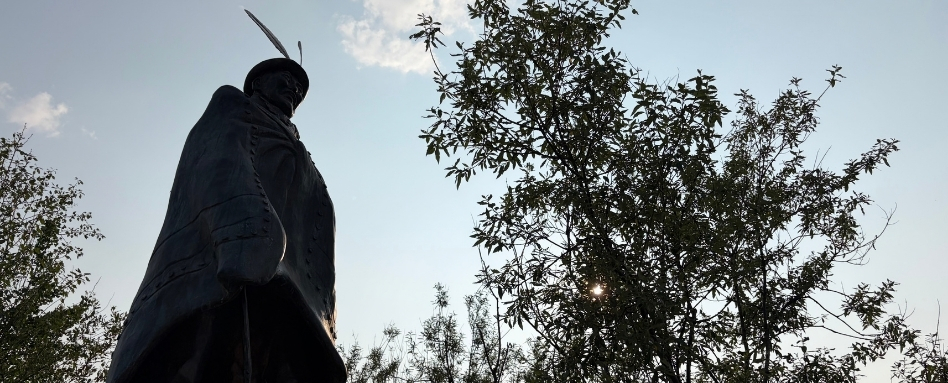
Photo credit: Bronwyn Preece
The intention to leave only footprints
As a visitor, I felt invited into a necessary process of understanding, of imagining … with a welcome embrace. This place was already holding me and my walking and being here — with the intention to leave only footprints — would find me practicing ways of reciprocating Tr’ëhudè, a Law of care. Walking the Trans Canada Trail around the perimetre of Dawson City would facilitate my process of learning, as the route is speckled with all sorts of informative, illustrative interpretive panels: it felt like a true gift, my footfalls given the opportunity to fall into a series of complex histories, learning as I went through moments of pause, of contemplation, of consideration.
From the stories of how the local Tr’ondëk Hwëch’ were displaced from their home with the arrival of tens of thousands of prospectors — relocated down river to Moosehide, by their visionary Chief Isaac in 1897, to try to safeguard his People from the onslaught; to stories of the notable landslide which served (and still serves) as a marker for river goers; from stories of paddlewheelers and floods; gambling to gold weighing; from boardwalks to that of a boom town … I was walking deeper and deeper into a living history.
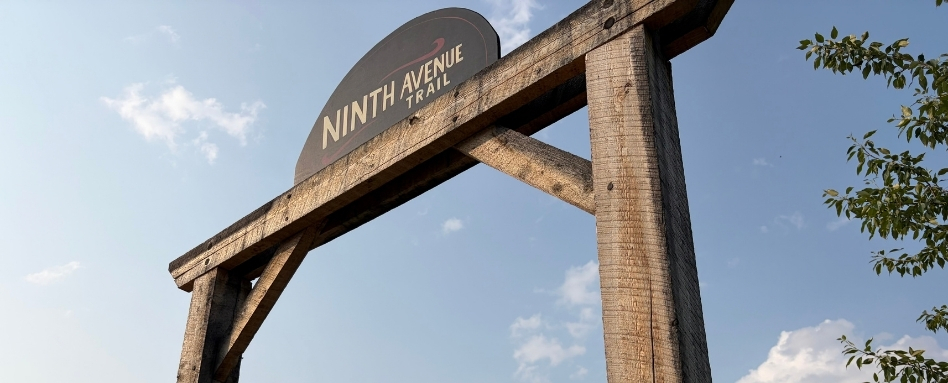
Photo credit: Bronwyn Preece
Following the flow of the Yukon River
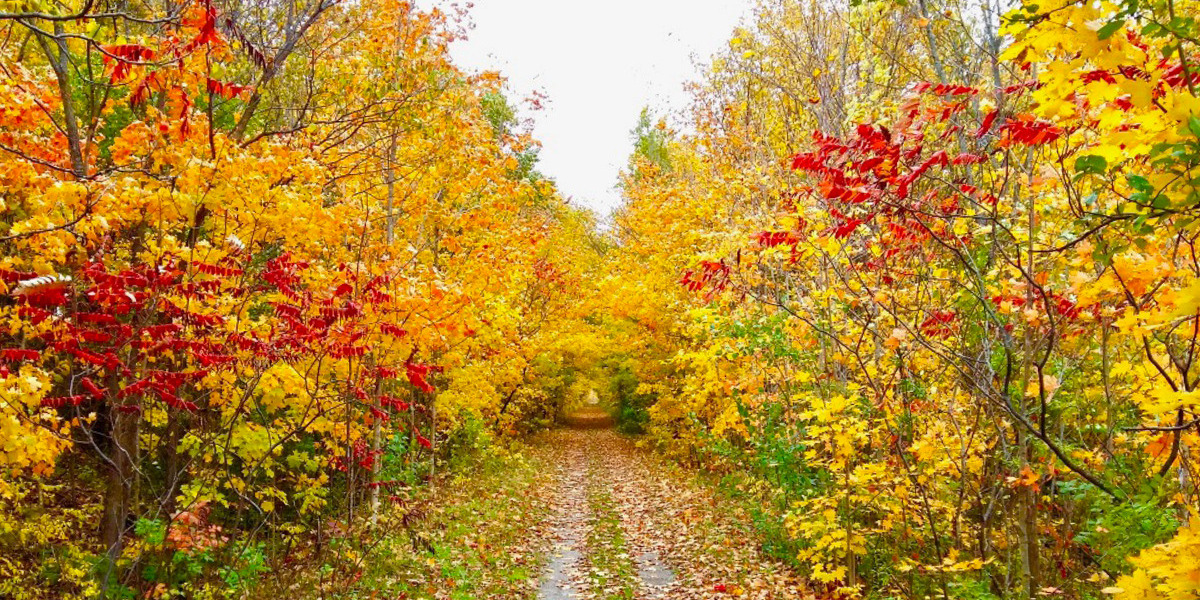
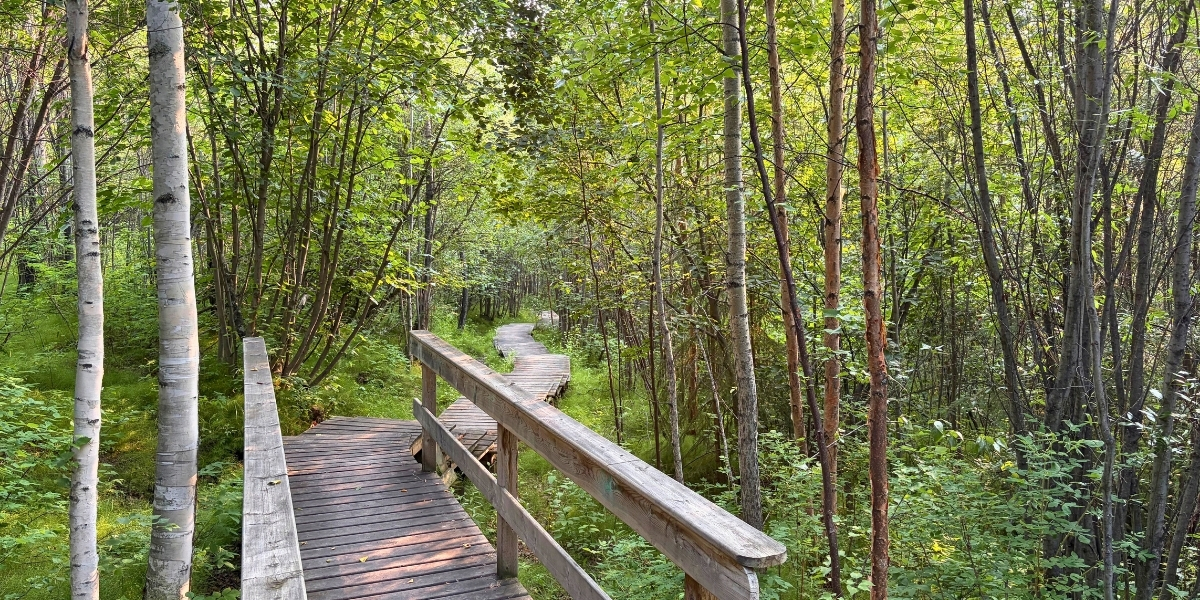
I walked clockwise, following the flow of the Yukon River. I would soon pass from dyke onto trail, fluttering green with Quaking Aspens. Buffaloberry and blue bellflower, larkspur and goldenrod would soon fray the edges, and as I began to climb slightly, the ground would reveal a forager’s dream of tiny wild strawberries. My mouth savoured the flavours of local. I was in the process of truly arriving.
I was following the Ninth Street Trail, part of the Dawson City Midnight Dome Trail Network. The Trans Canada Trail emblem featured on many of the signposts — welcome markers — along the route. As I wrote in a previous piece, “the significance of the Trans Canada Trail sign through my trailed travels has helped shape a new sense of place-making and relating-to-place: routing and rooting senses of local and national connectivity through wayfinding.” Again, this was proving true.
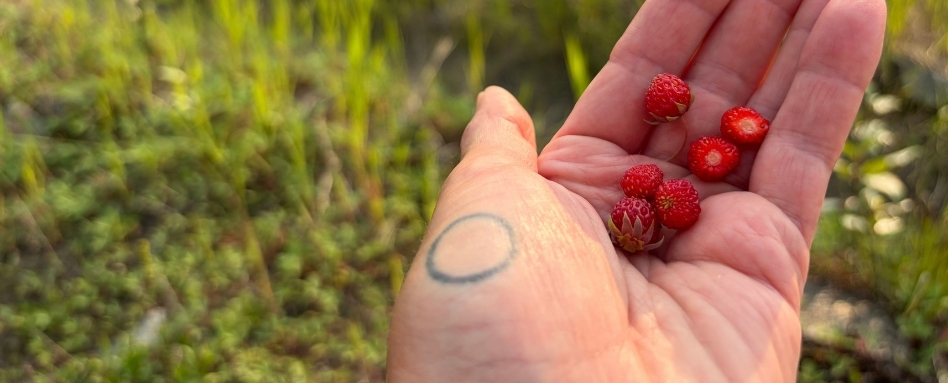
Photo credit: Bronwyn Preece
Experiencing Dawson City as a greenway network
I will admit that as I circled midway through my trek, experiencing Dawson City first as a greenway network, I did wonder for a brief moment if this was the best way to step into history. Should I have perhaps gone and sipped the sourtoe frozen cocktail or gone to a hurdy-gertie girl show as my point of entry rather than suddenly finding myself side-stepping mud, as the ground began to truly reveal itself? But this was an important step. An interpretative sign would soon elaborate on what was beneath my feet. I would learn about this being wet meadow lands that moose used to frequent, another would explain the situation of the permafrost (and reason behind the higgledly-piggedly buildings. There are few straight lines in Dawson City), and the immediate threats that the warming of this supportive layer means for the town. My moment of doubt was eschewed, as I quickly appreciated how this walk was expanding my understanding of all the hardships and challenges — many I knew and could have conceived and others I hadn’t — that being here either in yesteryear or now, entailed or entails.
Walking the Trail first was the right move. The depth of what I learned in that handful of kilometres would infuse my appreciation of what I was then better tuned to experience: the crooked, dusty streets, the musty beer parlours, and the Land Claims journey of Tr’ëhudè Hwëch’ and path to self-governance: all held together in the same, small place.
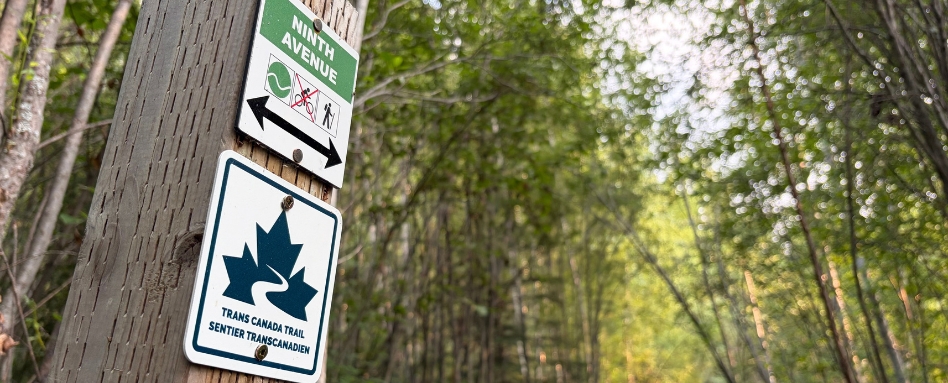
Photo credit: Bronwyn Preece
The Wooly Mammoth
And then there was the Wooly Mammoth, perhaps the best way to round out my circling of town. My walk of the Trans Canada Trail of Dawson would end near the statue of this ice-age mammal. The Yukon is home to a huge amount of fossils from the era. In 2022, a complete mummified baby mammoth was found in Tr’ondëk Hwëch’ Territory by a placer gold miner, reminding us that histories defy calendars, intersect in unusual and unsuspecting ways, threading topographies together in a tapestry of tales and trails of place.
This, I experienced, more than anywhere, in Dawson City.
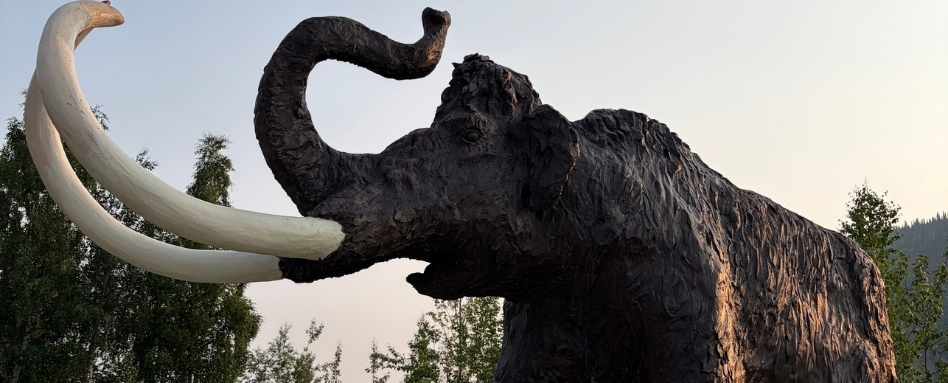
Photo credit: Bronwyn Preece
Bronwyn is a site-sensitive, poetic renegade and multi-disciplinary arts practitioner. Dubbed the “backcountry poet,” she holds a PhD in Performance, along with a MA and BFA in Applied Theatre. She has taught and performed internationally. Her latest book: ‘hiking beyond : poems from the trail’ was released in April with Caitlin Press. She is the author of ‘knee deep in high water : riding the Muskwa-Kechika, expedition poem’s (Caitlin Press, 2023); Sea to Sky Alphabet (Simply Read Books, 2024); Gulf Islands Alphabet (Simply Read Books, 2012) and the forthcoming Canadian Rockies Alphabet, Olive and Jasper, My Happy Hiking Trails and Waiting on Winter, all with Simply Read Books. Her artistic and educational work aims towards cultivating place-based awareness and small acts of reconciliatory repair. She has the word ‘gratitude’ tattooed on her arm.
**
The Trans Canada Trail is not just a trail; it’s the world’s longest multi-use trail network. It crosses every province and territory and connects all three coastlines. As an iconic shared national asset, it demonstrates what people across Canada can build together over generations.
Contact your local MP and let them know what the Trans Canada Trail means to you: https://notjustatrail.ca/
Feature photo credit: Bronwyn Preece.
¹,²Quotes credited to Elder Angie Joseph-Rear, seen on a signboard at the Parks Canada Visitor Centre/Headquarters in Dawson City.