
Honouring Women’s History on Montreal’s Trans Canada Trail

First a meeting place for diverse Indigenous peoples and now one of the world’s largest francophone cities, Montréal is home to many old and distinct histories.
Part of its once-hidden heritage is now showcased at Place des Montréalaises, located right next to City Hall. Developed by Lemay, AtkinsRéalis and independent artist Angela Silver, this civic plaza is both a monument to all Montreal women and a safe green space between several downtown neighbourhoods.
Explore this striking plaza along Montreal’s section of the Trans Canada Trail, which borders the public space on both sides.
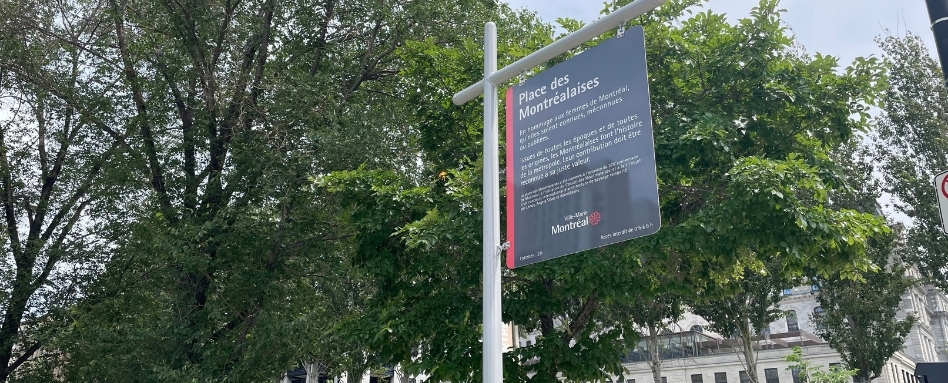
Photo credit: Jane O’Faherty
A place for celebration and recognition
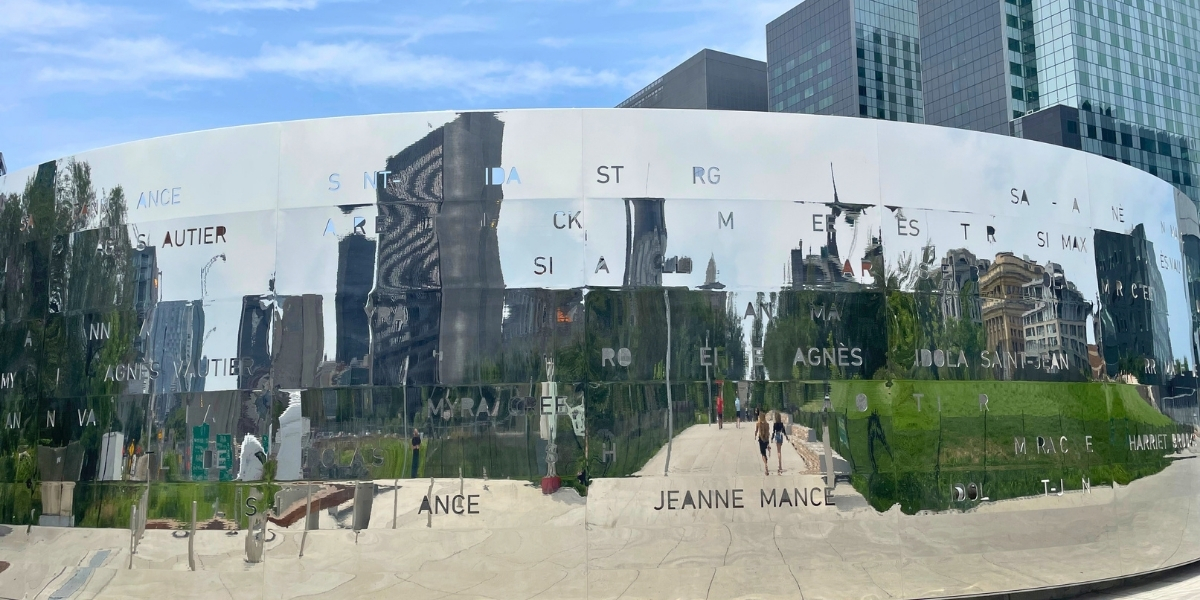
Entering the plaza, your eyes will immediately be drawn to a dramatic mirror sculpture west of Champ-de-Mars metro station. Designed by Angela Silver, this miroir des Montréalaises features the fragmented names of 21 notable women from this city.
Moments in history – both positive and negative – are remembered here. One side of the cylindrical structure is dedicated to the 14 victims of the femicide at École polytechnique in 1989.
The other side strikes a more celebratory tone, with the names of seven women who were game changers in Quebec society:
• Harriet Brooks, the first Canadian woman to become a nuclear physicist
• Myra Cree, a Mohawk broadcaster and author who became the first female news anchor for Radio-Canada’s Téléjournal program
• Jeanne Mance, a French nurse, settler and co-founder of Montreal
• Jessie Maxwell-Smith, a teacher who helped ensure Montreal’s Black community could access quality education
• Ida Roth Steinberg, a Hungarian-Jewish immigrant and founder of the first Steinberg grocery store
• Idola Saint-Jean, a feminist and journalist who campaigned for women’s right to vote in Quebec
• Agnès Vautier, a star player for the Western Hockey Team, considered the best women’s hockey team of the early 20th century
The isolated letters on the mirror invite visitors to think of women excluded from public memory, or to imagine the names of important women in their lives. The letters are echoed on the impressive concrete staircase nearby.
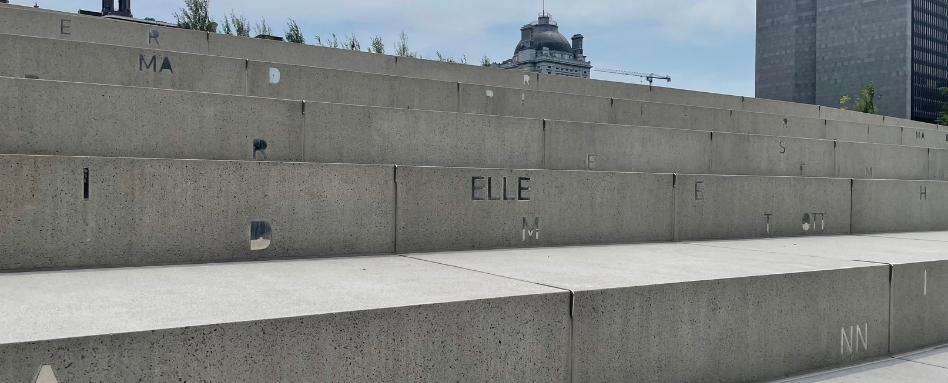
Photo credit: Jane O’Faherty
Remembering Marie-Joseph Angélique
Alongside these 21 women, the Place des Montréalaises also recognizes Marie-Joseph Angélique, a Black woman who has become a symbol of freedom and resistance.
Enslaved and brought to North America from Portugal, Angélique was sold to a Montreal family, who refused to her demand for freedom. The following year, she was accused of starting a fire that burned down much of Montreal’s merchant quarter.
Angélique vehemently denied the allegations. However, after more than 24 witnesses testified against her, she was tortured, found guilty and hanged.
Some historians believe Angélique set the fire in an act of rebellion and as a means of escaping Montreal. Others believe her status as a Black enslaved woman made her an easy scapegoat.
Regardless of whether or not she committed arson, her experience illustrates the brutal realities of slavery and violence against women in Canada.
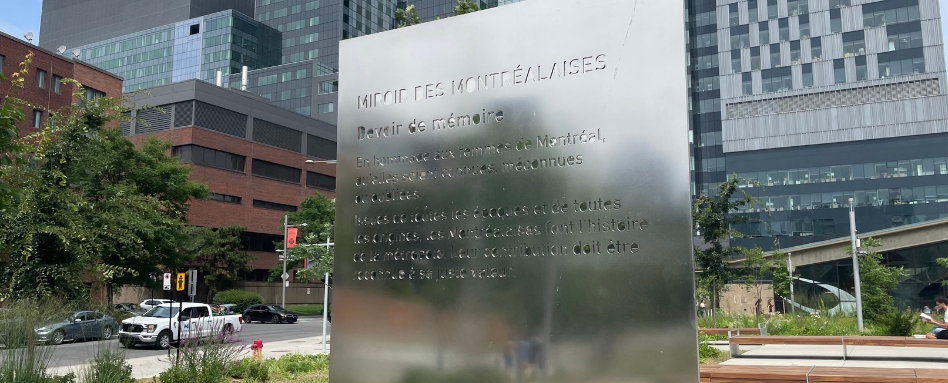
Photo credit: Jane O’Faherty
Reconnecting nearby neighbourhoods and nature
In addition to history, Place de Montréalaises is designed to preserve natural beauty and safety. For years, the area had been bisected by the Autoroute Ville-Marie, creating a noisy and uninviting experience for walkers and cyclists.
The civic plaza offers a counterpoint to that. Heading towards City Hall, climb up the concrete staircase – or use the accessible incline – to reach an elevated urban meadow. From here, you’ll take in jaw-dropping views of the Montreal skyline, the Old Port of Montreal and Chinatown.
Each of the meadow’s 21 plants is a tribute to one of the 21 Montreal women honoured in the plaza. The plants bloom one after the other each year, creating a constantly evolving green space.
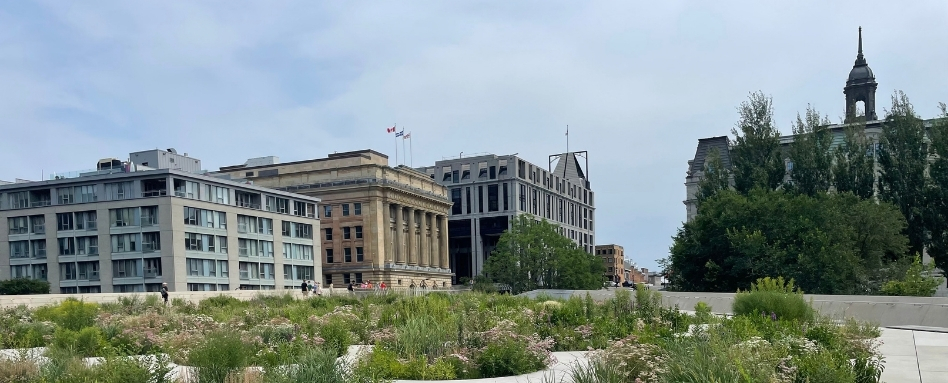
Photo credit: Jane O’Faherty
Find more history, culture and connection in Montreal
Accessible and deeply rooted in the city’s past and present, Place des Montréalaises fosters remembrance, connection and hope. To make the most of your visit, download the Portrait Sonore app for a free audio tour of the space. Available in French, the tour features insightful interviews with the plaza’s designers, historians and local leaders.
Later, follow the Trail toward Old Montreal, where every cobblestone street and charming museum brings you closer to the city’s rich history. For a more active adventure, check out the trail in urban parks like Parc Jean-Drapeau and the Lachine Canal National Historic Site.
Explore all of Montreal’s Trail sections on our interactive map!
Feature photo credit: Jane O’Faherty